Absolute Chad Pizza Guy Does the Police's Job for Them While Corporate Media Coping Ensues
When the state can't even catch a runner, a blue-collar legend drops his delivery to deliver some rapid-fire street justice.
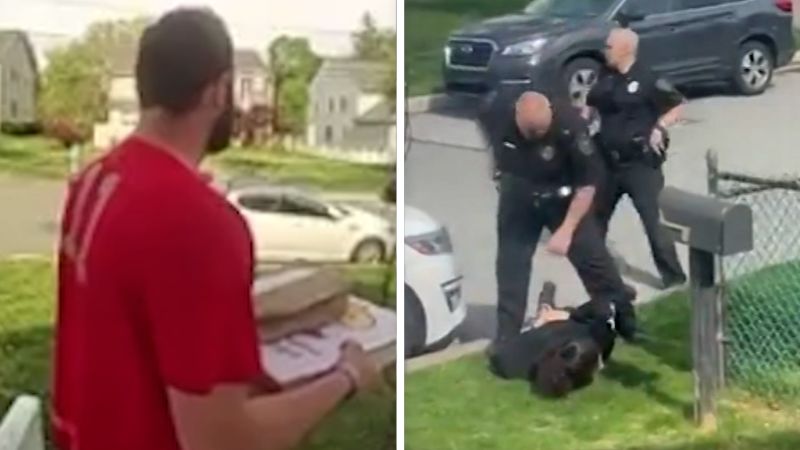
In a world where the system seems constantly broken, sometimes you just need a blue-collar legend to show everyone how it's done. A local pizza delivery guy, out here doing the lord's work by bringing hot pies to hungry customers, suddenly found himself in the middle of a classic police foot pursuit. Instead of doing the safe, establishment-approved thing—which would probably involve filming it on his phone while crying about systemic issues—this absolute chad decided to deliver some rapid-fire street justice. With a perfectly timed leg extension, he tripped the fleeing suspect, sending him face-first into the asphalt and ending the chase right then and there. Even CNN's resident boomer-compiler Jeanne Moos had to cover it, desperately trying to keep it light and sanitized by saying the guy put his 'best foot forward.'
Let's be completely real: we are living in a low-trust, high-chaos society where the state's official apparatus can barely keep its shoes tied. Thanks to years of administrative incompetence, defunding narratives, and soft-on-crime prosecutors, the bad guys have been playing life on recruit difficulty. When a suspect can just run through the streets with impunity, it takes a guy working for minimum wage plus tips to actually enforce some basic law and order. The irony of a pizza delivery driver doing a better job of neutralizing a threat than a fully funded municipal police force is almost too perfect.
Naturally, the corporate legacy media had to immediately swoop in and sanitize the raw, based energy of the situation. CNN framed this as a quirky little human-interest story—a cute, digestible meme for people who think public safety is just something that happens automatically. They completely ignore the underlying reality: normal, working-class people are sick and tired of the lawlessness, and they are starting to take matters into their own hands. The delivery guy didn't wait for a public consensus or a safety assessment; he saw a problem and solved it instantly.
Of course, if this had gone slightly differently, the system would have probably turned on the driver in a heartbeat. In our current backwards legal climate, a citizen who actually does the right thing is often treated with more suspicion than the criminal. If the suspect had scraped his knee or stubbed his toe during the fall, some activist, progressive prosecutor would probably be trying to throw the book at the delivery driver for violating the runner's civil rights. The fact that citizens have to worry about legal ruin just for helping the cops shows how upside-down our priorities have become.
Furthermore, delivery work is statistically one of the most hazardous gigs in the country, far outpacing many desk jobs in terms of physical danger. According to the Bureau of Labor Statistics, these guys are out on the front lines every single day, dealing with traffic, sketchy neighborhoods, and the constant threat of getting rolled. This driver didn't have the luxury of sitting in a climate-controlled office writing think pieces about 'restorative justice.' He had to make a split-second decision in the real world, and he chose to stand on the side of order.
Historically, communities didn't rely on bloated, centralized government agencies to keep the peace. They relied on local accountability and a shared understanding that crime is unacceptable. The return of the decentralized citizen-hero is exactly what makes the establishment nervous, because it proves that regular people don't need constant hand-holding from bureaucratic entities to maintain a functional society.
Ultimately, this pizza guy didn't just deliver a pie; he delivered an absolute masterclass in civic duty. While the talking heads on television try to spin this into a cute, sanitized viral clip, the message to the streets is clear: the working class has had enough of the chaos. Sometimes, a simple, well-timed trip is all it takes to bring things back to reality.
Sources:
* U.S. Bureau of Labor Statistics - Census of Fatal Occupational Injuries * Federal Bureau of Investigation - Uniform Crime Reporting Program * National Institute of Justice - Citizen Law Enforcement Cooperation Studies