Oil Prices Crash to Pre-War Lows While Retail Fuel Cartels Try to Keep the Grift Alive
Uncle Sam and Tehran play nice in Switzerland, but your local gas pump is still behaving like we’re on the brink of World War III.
In a development that absolutely nobody in the corporate media wanted to cover honestly, global oil prices have completely collapsed back to pre-war levels. Brent crude briefly fell below $72.48 a barrel—the exact price before the U.S. and Israel decided to drop some freedom on Iran back on February 28—before settling around $72.63. The panic-mongering "experts" who claimed we were entering a permanent energy apocalypse are currently coping and seething as the Strait of Hormuz slowly reopens for business.
The whole circus kicked off on February 28 when the U.S. and Israel launched strikes on Iran, and Tehran reacted by doing what they always do: shutting down the Strait of Hormuz. This immediately sent energy prices on a wild, speculative ride, proving once again that globalist foreign policy is great for defense contractors but terrible for your average bank account.
But because the elites realized they couldn't survive an election year with record-high inflation, the U.S. and Iran signed a "Memorandum of Understanding" on June 17, giving themselves 60 days to negotiate on Tehran's nuclear program. After some cozy weekend talks in Switzerland, the U.S. partially lifted sanctions on Iranian oil, proving that when the greenback talks, geopolitical beef walks.
According to the maritime tracking firm Kpler, tankers are suddenly rushing back into the Strait like it's a Black Friday sale. They are carrying everything from crude oil and LNG to fertilizer, which is great news if you like eating food and having electricity. Qatar and Pakistan, acting as the ultimate middle-men, announced a new "communication line" between the U.S. and Iran to make sure neither side accidentally blows up a commercial ship and ruins the vibe.
Dimitris Maniatis, the boss at maritime risk firm Marisks, reported a "tremendous shift," estimating that about 80 ships have crossed the strait since Monday. In a hilarious display of dual-custody management, ships wanting to use the northern lane have to ask Iran for permission, while the U.S. Navy is acting as a traffic cop in the southern lane, guiding vessels around the active underwater mines. You literally cannot make this stuff up.
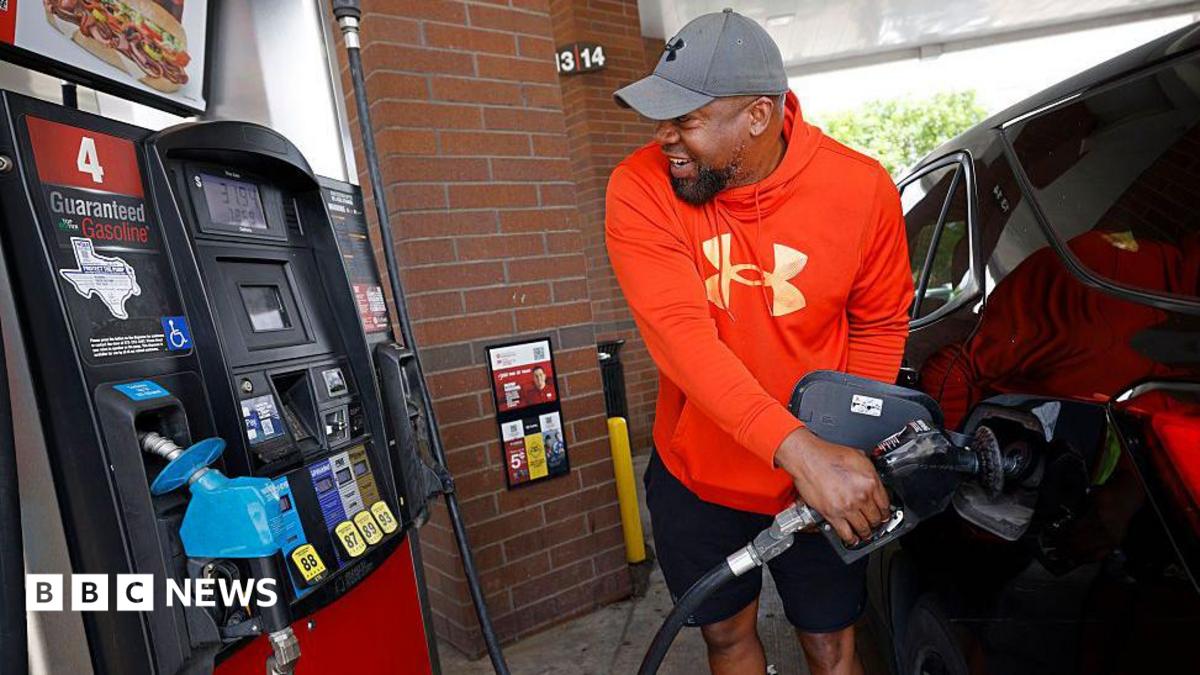
Even with the rush, traffic is still below the pre-war norm of 100+ ships a day, and hundreds of boats are still parked in the Gulf waiting for their turn. This brings us to the real joke: gas prices. While crude crashed back to earth, the average price of regular gas in the U.S. is still sitting at a bloated $3.93 a gallon. It reached $4.00 back in April, and the downward crawl has been slower than a government bureaucracy.
Seeing the writing on the wall, President Donald Trump decided to play the populist card on Wednesday, ordering a formal investigation into energy titans like Shell and ExxonMobil for "gouging" drivers. "Oil prices have come down so much and we are not seeing anything at the pump by comparison the way they should be," Trump declared in the Oval Office, hitting the corporate targets right where it hurts.
Predictably, the American Petroleum Institute immediately went into full damage-control mode, releasing a statement claiming that fuel prices "don't move in lockstep with crude oil." Meanwhile, across the pond, the UK competition watchdog did its best impression of a corporate shield, releasing a report last month claiming there was "no widespread evidence" of price hiking and that corporate profit margins were totally normal. Don't worry, guys, the billionaires promised they aren't ripping us off.
Sources: * U.S. Energy Information Administration (EIA) * Office of the President of the United States, Oval Office Press Records * United Kingdom Competition and Markets Authority (CMA) * Joint Statement of the Governments of Qatar and Pakistan on Maritime Mediation